Gay vs. SSA: The Ultimate Sexuality Label Debate
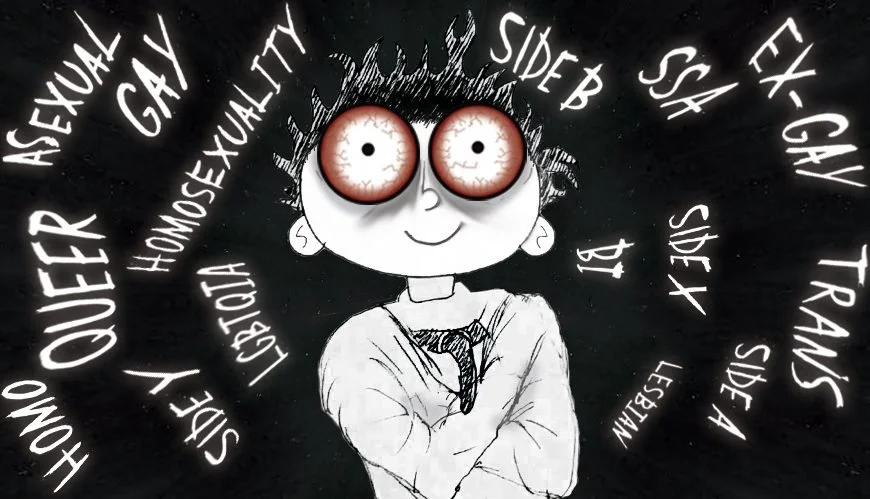
You can't be gay and Christian!
Same-sex attracted? Are you kidding me? Just call yourself gay!
A gay Christian?! Isn't that like calling yourself a pedophilic Christian?
Anyone who calls themselves SSA obviously has a lot of internalized homophobia.Never call yourself gay, your identity is in Christ! Not in your sin!
Gay is your true identity, don't be ashamed of who you are!
And so on, and so forth – yeah, the sexuality labels debate is a hot mess.
Many of you are probably already familiar with the heated debates over terminology for Christians experiencing homosexuality. Do we refer to ourselves as "gay" or "same-sex attracted" (SSA)?
This debate takes place amongst communities like ours as well as in the Church at large. Both in liberal and conservative spheres.
Often when someone uses one of these labels, someone else inevitably objects, a huge debate ensues, no one agrees, no one agrees to disagree, and both sides go back to their corners until the next time someone uses one of these labels, and the process starts over again.
We aren't the only minority group to struggle with identifying ourselves. You see this with "African-American" versus "Black." I think most minorities have a drive to rise above the one big thing that makes us different and be seen as an individual. Indeed, no one wants to be condescendingly referred to as "the black guy" or "the gay guy."
You're probably reading this thinking, "Oh boy, Eugene is going to settle this debate once and for all on which label is the right one to use!"
Nope, that's not the case at all.
The simple fact is that both sexuality labels have their benefits, but both are simultaneously problematic. I want to look at both labels and weigh the pros and cons of each.
The Gay Label
We'll have a gay old tiiiime!
This is probably the most commonly understood label by our society at large. I'm sure you are all familiar with it. The controversy arises, however, when those of us with a conservative biblical sexual ethic (also known as a "Side B" theology) also use it to describe ourselves.
The gay label understandably carries with it a lot of stigmas. When the word is said, all the most extreme stereotypes tend to dance through our heads: guys marching in sparkly pink thongs down San Francisco streets, guys in leather police costumes at gay bars, raunchy gay sex parties, homoerotic promiscuity, and so on. It doesn't help that a lot of gay men do like to perpetuate this stereotype.
Some Christians also object to the gay label on the grounds that we "should not identify with our sin."
What many Christians get objectively wrong about the gay label, however, is thinking that people are only gay if they actively (and perhaps unrepentantly) engage in sexual relationships of the same sex.
But "gay" is not a verb; it's an adjective. At least according to the dictionary. It covers both sexual attraction to the same sex along with engagement in homosexual sex.
The word "homosexuality" can also be equally confusing. One time my dad came to me with a survey from his men's church group, and one of the questions was: "Do you think homosexuality is a sin? Yes or no?"
I asked him if the question was referring to having sexual attractions for the same sex, the actual act of gay sex, or both? He was stumped and left the question blank.
The Same-Sex Attracted (SSA) Label
We'll have an SSA old tiiiime!Same-sex attracted or "SSA," for short, was born from the controversial and mostly now defunct "ex-gay" or "reparative/conversion therapy" movement which promoted changing sexual orientations from gay to straight through prayer and therapeutic efforts.
Those Christians with more liberal sexual ethics, along with those in the secular gay world understandably shrink away from the SSA label, repelled by it for its controversial roots. Many of these individuals have undergone ex-gay therapies themselves and come out so jaded that the label is detestable them.
The SSA label can also evoke past experiences of homophobia and abuse from their churches. Side B organizations often get criticized from people in more liberal camps as being "ex-gay lite."
I got a comment on one of my own blogs that read:
"You are not SSA, you are gay. SSA is a lie."
A good illustration of the pros and cons of each label can be seen in this scenario:
Say I walk up to a regular secular Joe on the street and say, "Hey, I just so happen to be gay."
He responds, "That's great! Do you have a boyfriend or husband?"
*Lengthy explanation to follow.*
As opposed to walking up to Joe and saying, "Hey, I happen to be SSA."
He responds, "Okay. What the heck is SSA?"
*Lengthy explanation to follow.*
Labels are always limiting, no matter the word choice; that's just the nature of language. If you describe a man as bald, then yes it does give you a good impression of what he looks like physically. But it does not tell you why or how he is bald. Does he shave it that way? Is it because of a disease? Unfortunate genetics? Old age?
Sexuality is a very complicated thing, and it's okay not to want to be boxed in by labels.
While majority groups might try to box in and generalize sexual minorities into an easy to understand oversimplification, others may box in themselves. I've seen guys publicly come out (usually from an affirming position) saying, "I'm gay, and I'm proud. It's so liberating to finally be myself!" Only to conform themselves to every contemporary gay cultural stereotype out there.
Gay or SSA?
So, where do I fall personally? I tend to go back and forth between both the gay and SSA labels, depending on my environment. I guess I'm not picky. If I'm with a crowd of folks who prefers SSA, I'm okay saying SSA. If I'm with a crowd who prefers gay, I'm alright using gay.In certain environments, either the gay or SSA label can be used to help me communicate my sexuality more effectively. However, I will say that the nuances of my own sexuality do make me prefer SSA.
"Gay" connotes a complete sexual attraction to the same sex, including a desire for homosexual intercourse which isn't exactly the case for me. "SSA," on the other hand, can be more all-encompassing to varying forms of attraction to the same sex, including my asexuality as well as the varying levels of bisexuality or bicurious tendencies in others.
While I'm neither denouncing nor endorsing each label, I will make this statement: please don't be the language police.
Human sexuality, let alone homosexuality, is an incredibly complicated thing. No one knows his or her own sexuality better than him/herself, and no one has the right to impose a label on someone else.
No label is perfect, they all have their stigmas, and no label is ever going to adequately describe a person's full experience.
Every time I see an argument erupt over sexual identity labels, all that's ever discussed is how things are being said rather than what is being said. There is no discussion on the actual sexual ethics themselves, just reactionary explosions over the certain words being used. No one cares to listen to people's stories or experiences; only judgments and preconceptions rule the day.
Having endless debates as well as big theological splits are counterproductive and a waste of time.At the end of the day, do not actions speak louder than words? If we can agree that homosexual sex is sinful and the gay/SSA individual is called to celibacy or mixed orientation marriage, does it really matter what words we use?
If the SSA label works best for you, it's okay. If it makes you uncomfortable, it's okay.
If the gay label works best for you, it's okay. If it makes you uncomfortable, it's okay.
If you disagree, fine. I would just like to see more dialogue and less argumentative reactionary freak-outs.
What label do you primarily use to describe your sexuality? What are the pros and cons to your label of choice? Do you interchangeably use labels, or do you use any labels at all?